SEND
Our SENCO (leader of learning success) is Lisa Drogomirecki, her working days are :-
Tuesday and Thursday - all day
Wednesday and Friday - Morning only.
Please contact her through the school office or via email -
lisa.drogomirecki@weald.sch.kent.sch.uk
The Local Offer, Kent
All Local Authorities are required to publish information on ‘the Local Offer’ about all SEND services, along with details of any eligibility for specialist services and a signpost to support for those who do not meet thresholds.
http://www.kent.gov.uk/education-and-children/special-educational-needs
Useful websites for parents
Partnership with parents: partnershipwithparents@kent.gov.uk
National Association of Special Educational Needs: www.nasen.org.uk
Kent West Dyslexia Association: www.kentwestdyslexia.org.uk
Dyspraxia Foundation: www.dyspraxiafoundation.org.uk
National Autism Society: www.autism.org.uk
Attention Deficit Hyperactivity Disorder: www.adhd.org.uk
Asthma UK: www.asthma.org.uk
Deaf Association: www.ndcs.org.uk
Blind Association: www.rnib.org.uk
Young Healthy Minds: www.cxk.org.uk
More detailed information about special educational needs and disabilities can be found in our SEND policy.
The Four Areas of Need
What are the four areas of need?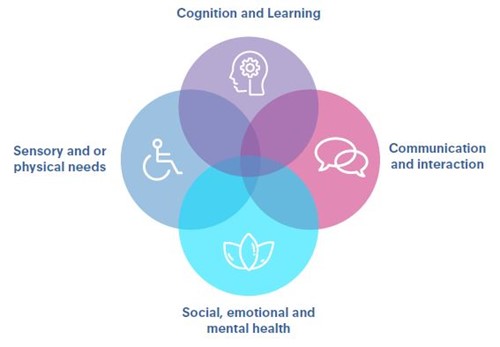
- Communication and interaction
- Cognition and learning
- Social, emotional and mental health difficulties
- Sensory and/or physical needs
Communication and Interaction (C&I)
Children may have difficulties with speech, language and communication. This can include challenges in understanding what is being said to them, expressing themselves, or using language socially. It also includes conditions such as Autism Spectrum Condition (ASC), where children may find social communication and interaction more difficult.

Cognition and Learning (C&L)
This area covers difficulties with learning, thinking and understanding. Children may learn at a slower pace than their peers, struggle with memory, processing information, or acquiring basic literacy and numeracy skills. It includes specific learning difficulties such as dyslexia, dyscalculia and dyspraxia, as well as moderate or more complex learning needs.

Social, Emotional and Mental Health (SEMH)
Children may experience challenges in managing their emotions, forming positive relationships, or maintaining good mental wellbeing. This can show itself in many ways, such as anxiety, low mood, difficulties with attention, or behaviour that reflects underlying emotional needs. SEMH needs can affect a child’s ability to engage positively with school life.

Sensory and / or Physical Needs (SPN)
Some children have physical disabilities or sensory differences that affect their access to learning. This may include visual or hearing impairments, sensory processing differences, or physical conditions that impact mobility, coordination or independence. These children may require adaptations, equipment or specialist support to fully participate in school.